Nearly half of the web's biggest sites send no Content-Security-Policy
On this page
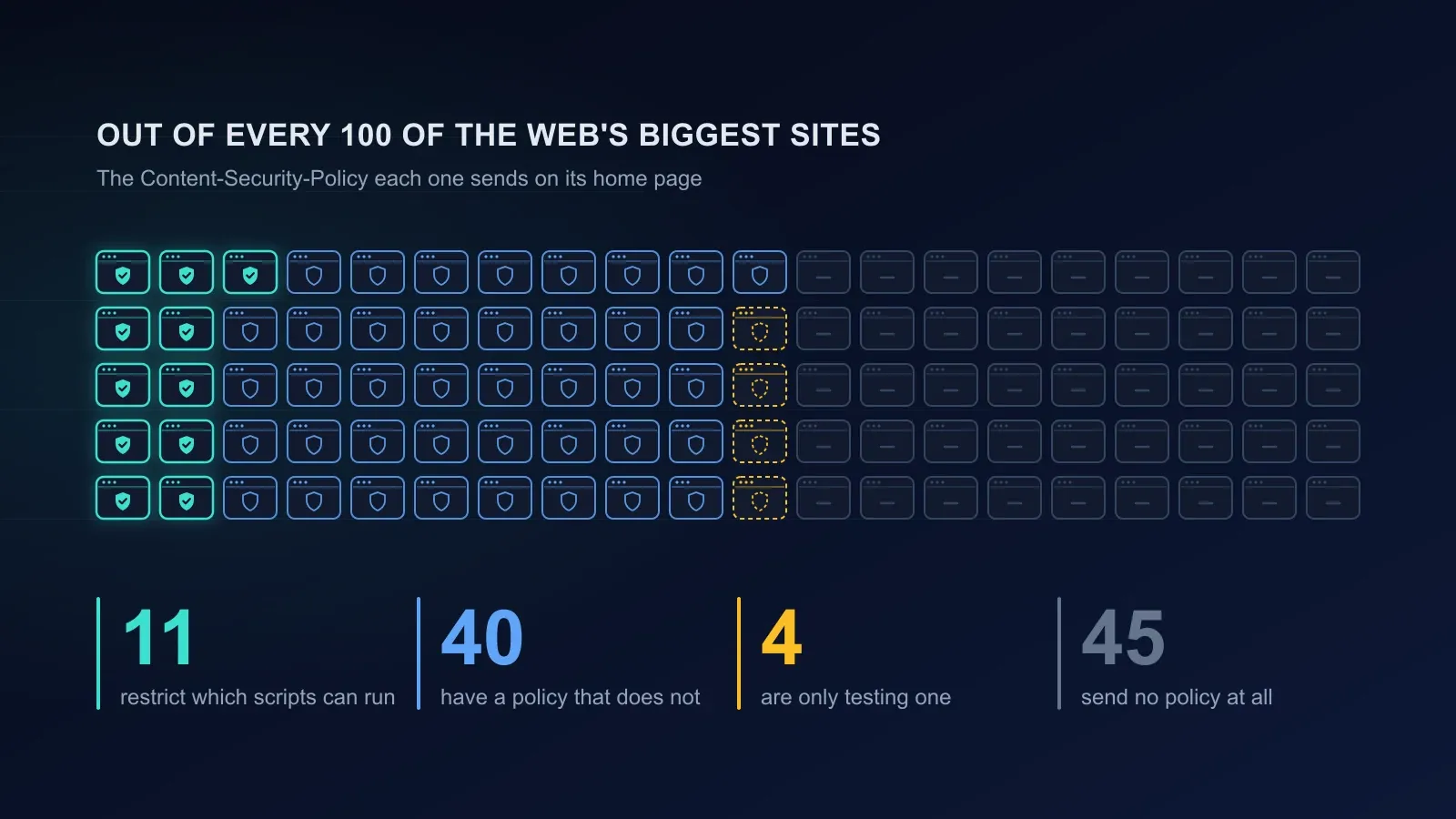
We checked the security headers of the 1,000 most visited websites on 14 November 2026. Of the 636 that answered with a page we could read, 45% send no Content-Security-Policy, 36% send no usable HSTS header, and only 11% send a policy that restricts which scripts can run. Three in ten send all four basic protections. Nearly one in five sends none.
Security headers are instructions a website sends to the browser with every page: only load this site over HTTPS, do not let other sites put this page in a frame, only run scripts from these places. They cost nothing and they close whole classes of attack. So we wanted to know how the best-resourced sites on the web use them, and what a smaller site can take from the answer.
We used our free Security Headers Checker on the top 1,000 names of the Tranco list, a research ranking of the most visited sites. Each name got one check of its home page.
What we could read
Of the 1,000 names, 636 answered with a page we could grade. The other 364 are worth a line, because they say something about such lists:
- 220 names have no website at all. They are the addresses of content networks, name servers and app back ends, which rank high because every device talks to them.
- 78 answered our checker with a bot challenge instead of the page. We do not guess what is behind a challenge.
- 66 timed out, dropped the connection, failed the TLS handshake or were declined.
Everything below is a share of the 636.
The four basics are far from universal
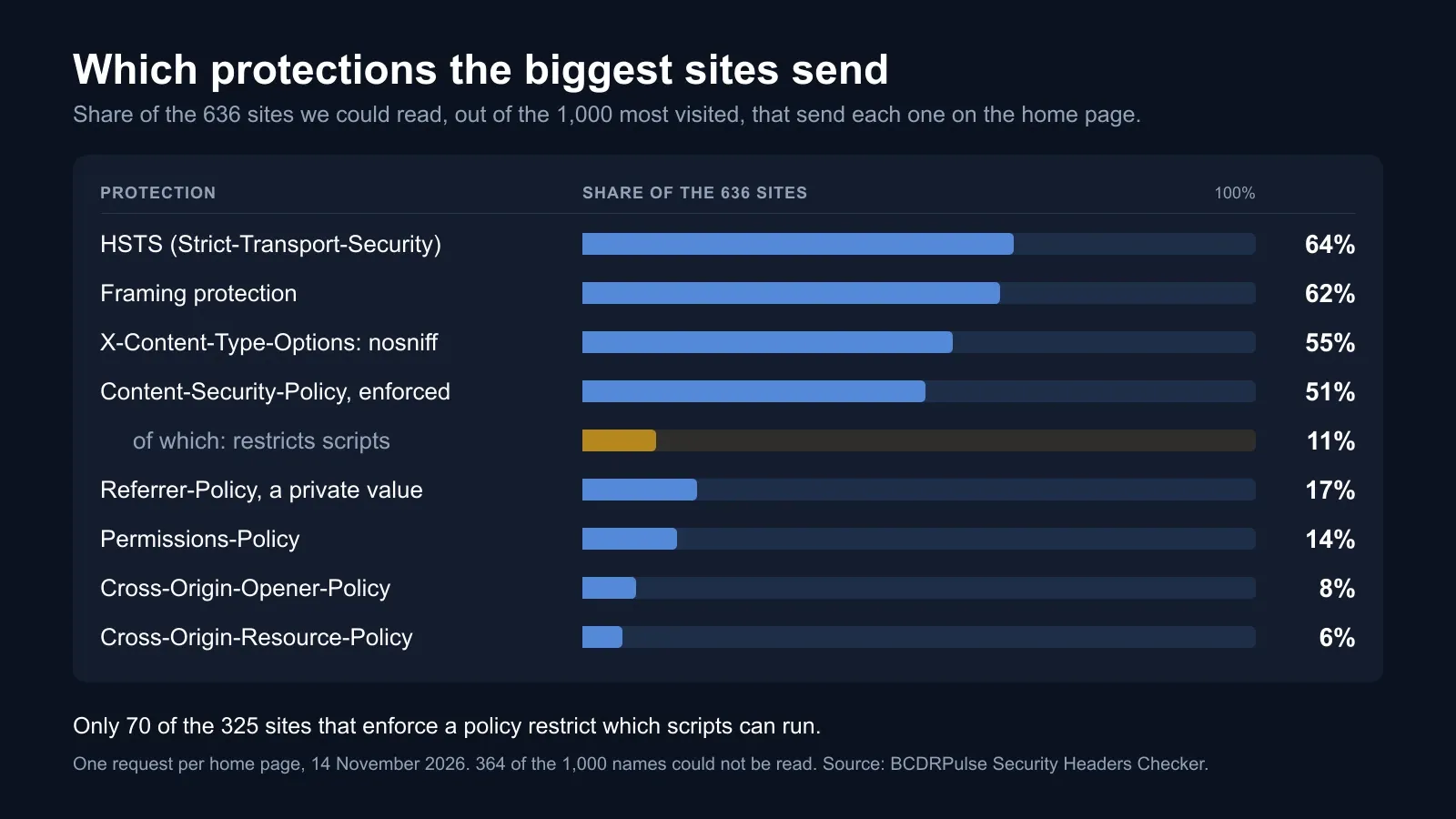
Four headers cover the attacks every site faces: HSTS keeps visitors on HTTPS, a Content-Security-Policy limits what an injected script can do, framing protection stops clickjacking, and X-Content-Type-Options: nosniff stops the browser guessing file types.
| Protection | Sites that send it |
|---|---|
| HSTS | 64% |
| Framing protection | 62% |
| nosniff | 55% |
| Content-Security-Policy, enforced | 51% |
Three in ten sites (30%) send all four. Nearly one in five (18%) sends none.
A policy is not the same as protection
Half of the sites enforce a Content-Security-Policy. Far fewer are protected by it.
A policy’s main job is to stop cross-site scripting, and it only does so when it restricts which scripts may run. Of the 325 policies we read:
- 39% name neither
script-srcnordefault-src. They are used for something else, such as framing rules, and place no limit on scripts. - 34% allow inline script with no nonce or hash, which is the very thing an attacker injects.
- 39% allow
eval. - 22% allow scripts from any host through a wildcard or a bare
https:.
Only 70 sites, 11% of the 636, send a policy that restricts scripts. A further 23 sites run a policy in report-only mode with nothing enforced yet, which is the right way to start.
HSTS: present, often half set
HSTS is the most common of the four, and the detail matters:
- Half of all sites (50%) set it for a year or more. Another 14% set a shorter time.
- Of the sites with HSTS, 45% leave out
includeSubDomains, so their subdomains can still be reached over plain HTTP. - 17% are on the preload list that browsers ship with, the only form that protects a visitor’s very first request.
- On 11% of sites, plain HTTP does not redirect to HTTPS at all.
HSTS is one part of a site’s HTTPS setup. Our guide to checking a TLS configuration covers the rest: protocol versions, cipher suites and the certificate chain.
Cookies
A little over half of the sites (57%) set a cookie on the first response. A third of those put every protective flag on every cookie. Of the sites that set a cookie:
- 63% set a cookie without
SameSite. Chromium-based browsers treat such a cookie asLax; not every browser does. - 44% set a cookie without
Secure. - 14% set what looks like a session cookie without
HttpOnly, so a script on the page can read it.
The newer headers are rare
| Header | Sites that send it |
|---|---|
| Referrer-Policy, with a private value | 17% |
| Permissions-Policy | 14% |
| Cross-Origin-Opener-Policy | 8% |
| Cross-Origin-Resource-Policy | 6% |
Three sites of the 636 send all four.
One caution about the first row. A site with no Referrer-Policy is not exposed: browsers now apply strict-origin-when-cross-origin by themselves, which keeps the path and query of a page private from other sites. That covers 71% of this list. The real problem is the 11% that set a value which sends other sites more than that default does.
Leftovers
- 26% still switch on
X-XSS-Protection, a filter that browsers removed years ago. - 22% announce their server software or its version in a header.
- 29% publish a
security.txtfile so that a researcher knows where to report a problem. More than a third of those files have a fault, most often no expiry date. - Of the 391 sites that load scripts or styles from another origin, 12 put an integrity value on all of them.
And the grades
Our checker turns all of the above into one letter. It counts what a browser will enforce, so a header that is present but ignored earns nothing.
| Grade | Sites | Share |
|---|---|---|
| A+ or A | 0 | 0% |
| B | 40 | 6% |
| C | 107 | 17% |
| D | 153 | 24% |
| F | 336 | 53% |
No site of the 636 earned an A. The best eight came within five points of one, and most of them were short by the same things: a script policy that could be stricter, and one or two of the newer headers.
Rank helps, up to a point. Among the top 100 names, 35% failed and 18% earned a B. From 501 to 1,000, 56% failed and 3% earned a B.
An A is not out of reach. The same rules give this site an A+, which says more about its size than its merit: one small site, one team, nothing inherited.
What this means for a smaller site
The biggest sites carry years of old pages, third-party tags and teams that each own a part. A small site has none of that, which makes the basics a short job:
- Redirect plain HTTP to HTTPS and send
Strict-Transport-Security: max-age=31536000; includeSubDomains, once every subdomain serves HTTPS. - Send
X-Content-Type-Options: nosniff. - Send
Content-Security-Policy: frame-ancestors 'self'orX-Frame-Options: SAMEORIGIN. - Put
Secure,HttpOnlyandSameSiteon the session cookie. - Start a Content-Security-Policy in report-only mode, read what it reports, then enforce it. This is the one that takes care.
The first four take minutes and already put a site ahead of most of this list. Our Security Headers Checker shows which of these a site sends and gives the lines to add for the common servers and hosts.
How we measured
- The list: Tranco, as downloaded on 14 November 2026, the first 1,000 names.
- One request per name: the home page of the name as listed, followed through its redirects, from one location in the United States. The final response was read.
- A site can send different headers on other pages, to other countries, or to a signed-in visitor. This is a snapshot of one page on one day.
- Names that are not websites, and sites that challenged or refused the check, are counted as not read and are in none of the percentages.
- We name no site. One request from one place is not a fair basis for calling out a company.
- The grades are those of version 1.1 of our rules, applied to the responses recorded on that day. The rules are published with the checker. This list was also the test of the rules themselves: it showed where the first version charged the same weakness twice, and the changelog lists what we corrected before publishing these grades.
Sources.
- 1. Tranco: A Research-Oriented Top Sites Ranking Hardened Against Manipulation (Le Pochat and others, NDSS 2019) (opens in a new tab) www.ndss-symposium.org
- 2. Tranco list, as downloaded on 14 November 2026 (opens in a new tab) tranco-list.eu
- 3. W3C, Content Security Policy Level 3 (opens in a new tab) www.w3.org
- 4. MDN Web Docs, Content-Security-Policy (opens in a new tab) developer.mozilla.org
- 5. web.dev, Mitigate cross-site scripting (XSS) with a strict Content Security Policy (CSP) (opens in a new tab) web.dev
- 6. IETF RFC 6797, HTTP Strict Transport Security (November 2012) (opens in a new tab) datatracker.ietf.org
- 7. HSTS preload list submission requirements (opens in a new tab) hstspreload.org
- 8. W3C, Referrer Policy (opens in a new tab) www.w3.org
- 9. MDN Web Docs, Referrer-Policy (strict-origin-when-cross-origin is the default) (opens in a new tab) developer.mozilla.org
- 10. MDN Web Docs, Set-Cookie (the Secure, HttpOnly and SameSite attributes) (opens in a new tab) developer.mozilla.org
- 11. MDN Web Docs, X-XSS-Protection (deprecated) (opens in a new tab) developer.mozilla.org
- 12. IETF RFC 9116, A File Format to Aid in Security Vulnerability Disclosure (April 2022) (opens in a new tab) datatracker.ietf.org
- 13. BCDRPulse Security Headers Checker: how the grade is worked out (opens in a new tab) bcdrpulse.com
- 14. BCDRPulse tools changelog (grade v1.1, 14 November 2026) (opens in a new tab) bcdrpulse.com
Frequently asked questions.
What are HTTP security headers?
Instructions a website sends to the browser with each response. The four basic ones tell the browser to use HTTPS only (Strict-Transport-Security), to limit which scripts may run (Content-Security-Policy), to refuse to show the page inside another site's frame (frame-ancestors or X-Frame-Options), and not to guess file types (X-Content-Type-Options: nosniff). They cost nothing to send and close whole classes of attack.
How many of the biggest websites use a Content-Security-Policy?
In our check of 14 November 2026, 51% of the 636 sites we could read enforced a Content-Security-Policy on the home page, a further 4% ran one in report-only mode, and 45% sent none. Only 11% sent a policy that restricts which scripts can run.
Does a Content-Security-Policy protect a site from cross-site scripting?
Only when it restricts scripts. A policy with no script-src or default-src, one that allows inline script without a nonce or hash, or one that allows scripts from any host places little or no limit on an injected script. Of the 325 enforced policies we read, 39% named neither directive and 34% allowed inline script with no nonce or hash.
Is a missing Referrer-Policy header a security problem?
No. When a site sends no Referrer-Policy, browsers apply strict-origin-when-cross-origin by themselves, which gives other sites the origin only and keeps the path and query private. The real problem is a value that sends more than that default, such as unsafe-url or no-referrer-when-downgrade. 11% of the sites we read set such a value.
What does includeSubDomains do in an HSTS header?
It extends the HTTPS-only rule to every subdomain. Without it a visitor can still be sent to a subdomain over plain HTTP, where someone on the network can read or change the page. 45% of the sites with HSTS in our check left it out. Add it once every subdomain serves HTTPS.
What is HSTS preloading?
Browsers ship with a list of domains that must always be reached over HTTPS. A domain on that list is protected even on a visitor's first request, before any header has been seen. The list requires a max-age of at least a year, includeSubDomains and the preload word, and removal takes months, so join it only when every subdomain is on HTTPS for good. 17% of the sites we read are on the list.
Why did none of the biggest sites get an A?
Our grade is the lower of two scores: how many of the protections a site sends in a form the browser enforces, and how much the weaknesses in them take away. An A needs 85 out of 100 on both. The best eight sites scored 80 to 83, and most of them were short of a stricter script policy and one or two of the newer cross-origin headers. The rules are published, and the same rules give bcdrpulse.com an A+.
Why could 364 of the 1,000 names not be checked?
220 are not websites: they are the addresses of content networks, name servers and app back ends, which rank high because every device talks to them. 78 answered our checker with a bot challenge instead of the page, and 66 timed out, dropped the connection, failed the TLS handshake or were declined. None of these is counted in the percentages.
Published .
Founder, BCDRPulse
Founder of BCDRPulse. Enterprise backup and data protection since 2007, supporting Fortune 500 companies. Writes guides to keeping a site up, fast and secure, and to proving it.